

Why is Now the Optimal Time to Shift Your Focus to Artificial Intelligence
The State of AI Implementation Today
Many manufacturers are being asked to start using AI today, but aren’t given much direction or use cases to find ways to implement AI. This often raises questions such as:
- What can AI do today?
- Where should I deploy AI?
- What problems am I trying to solve?
- How are my competitors using AI?
- Is it delivering measurable results?
- How should success be defined?
The key to answering these questions that so many manufacturers are asking is to plan for what’s next. The goal is to work towards zero unplanned downtime, actionable insights from complex sensor data, upskill the workforce, and establish trust with both your customers and employees.
What is AIoT?
AIoT (Artificial Intelligence of Things) combines artificial intelligence with data collected from connected machines, sensors, and industrial equipment. By analyzing this real-time data, AI helps manufacturers make faster decisions, improve processes, predict equipment failures, and optimize operations.
Common Manufacturing Use Cases: The Reality of What Works Today
Supply Chain Optimization: AI improves supply chain planning by forecasting demand, raw material pricing, and other external variables. Better forecasting helps reduce excess inventory, avoid costly expedited shipping, minimize stock shortages, and lower carrying costs while improving overall operational efficiency.
Predictive Maintenance: AI can be utilized in predictive maintenance to prevent downtime and improve asset efficiency. To maximize asset uptime, manufacturers can leverage IoT flight and repair data to detect early failure signs and improve availability.
Predictive Quality: Reduce warranty exposure and boost first-pass yield with real-time insights and decisions. Lower warranty costs by detecting emerging product issues through field data analytics. Prevent downtime by detecting real-time product defects with computer vision.
Worker Safety: Enhance worker safety and reduce costs by using computer vision for real-time hazard and PPE detection.
Sustainability: Optimize energy usage and reduce emissions through explainable AI and real-time operations recommendations.
Statistics to Pay Attention To
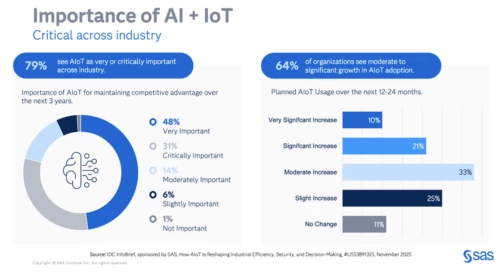
AI enables users to unlock big gains both financially and operationally. Organizations that heavily use AI in IoT are twice as likely to report that benefits significantly exceed expectations.
A Global Leader in AIoT
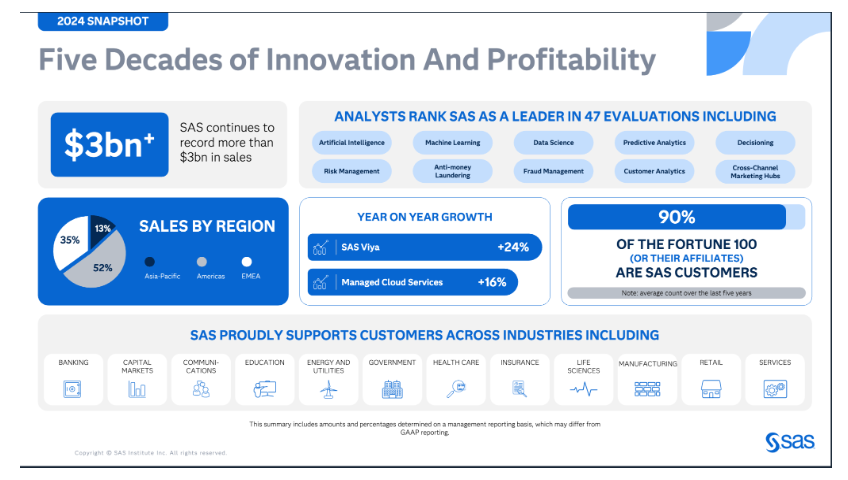
SAS combines advanced analytics, AI, and forecasting capabilities to help manufacturers make more informed operational decisions. By incorporating external data and predictive modeling, organizations can improve planning accuracy and respond more quickly to changing business conditions.
How the Industrial Solutions Network Helps
The Industrial Solutions Network partners with SAS to help OEMs, end-user manufacturers, and systems integrators evaluate how AI can optimize their decision-making and data outputs.
Whether you are exploring AI for optimization capabilities, predictive quality and safety, or sustainability initiatives, ISN specialists can help you understand how AI with SAS supports better forecasting and planning for what’s next.